
Canada's Lending Market Hits Equilibrium: Rates Hold as Mortgage Approvals Surge
Bank of Canada maintains 2.25% policy rate while Q4 2025 mortgage volumes jump to $28.7B, signaling stability in Canada's $2.3 trillion lending market
Key Statistics
BoC Policy Rate
2.25%
Q4 2025 Mortgage Volume
$28.7B
Insured Mortgage Growth
+40%
Household Debt-to-Income
177.2%
2026 Renewal Share
20-25%
Fintech LaaS Growth
+191%
Executive Summary
Canada's lending market has entered a period of remarkable stability in early 2026, with the Bank of Canada holding rates steady at 2.25% for the seventh consecutive month. This equilibrium comes as mortgage approvals surge to $28.7 billion in Q4 2025, driven by a 40% spike in insured mortgage volumes. While household debt reaches 177.2% of income, lower interest costs are easing payment pressures. The fintech lending sector shows particular strength, with companies like Propel Holdings reporting triple-digit growth in lending-as-a-service revenue. As 20-25% of Canadian mortgages face renewal in 2026, the market watches closely for signs of change ahead of the April 29 rate announcement.
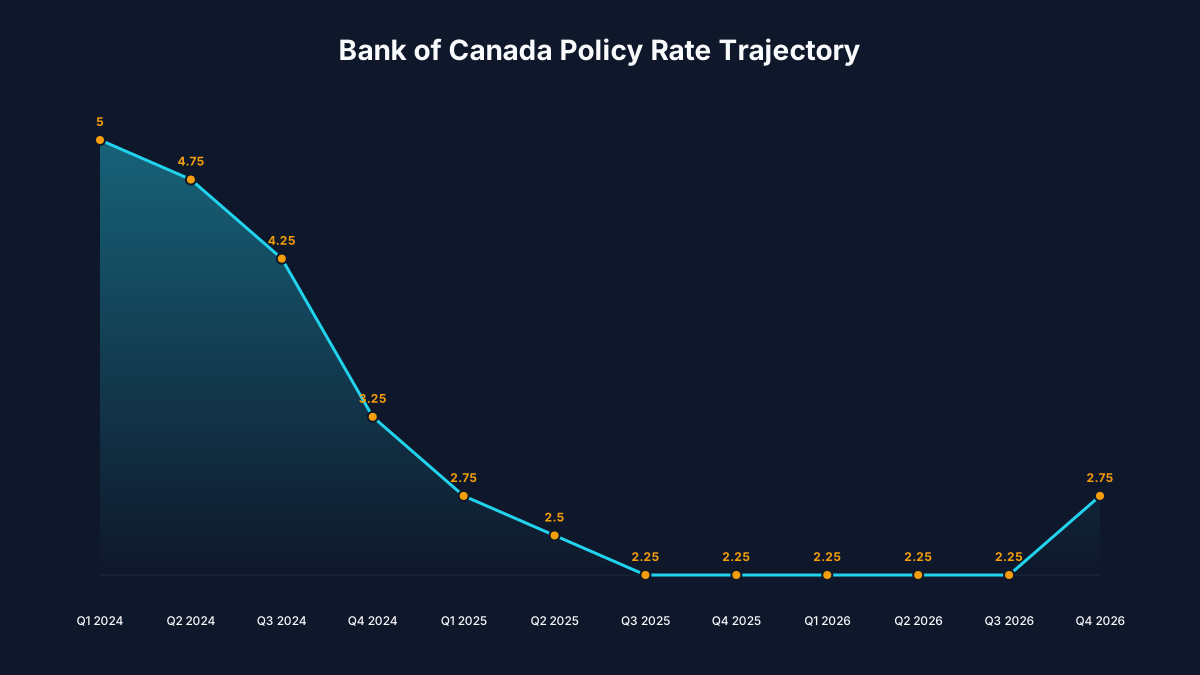
Bank of Canada Policy Rate Trajectory
Quarterly Mortgage Borrowing Volumes ($ Billions)
The New Normal: Understanding Canada's 2026 Lending Landscape
Picture this: You're a Canadian homeowner who locked in a mortgage rate during the pandemic's ultra-low interest environment. Now, as your renewal approaches in 2026, you're facing a completely different lending landscape. You're not alone — roughly one in four Canadian mortgage holders are in the same boat this year, navigating waters that have settled into an unexpected calm after years of turbulence.
The Bank of Canada's decision to hold its policy rate at 2.25% through March 2026 marks a turning point in the country's lending market. After the wild ride from near-zero pandemic rates to the 5.0% peak in 2024, this stability feels almost foreign. Yet it's exactly what the market needed — and the data shows Canadians are responding accordingly.
Rate Stability: The New Reality for Canadian Borrowers
Here's the thing about interest rates in 2026: they've become remarkably predictable. The Bank of Canada's March 18 decision to maintain the policy rate at 2.25% wasn't a surprise to anyone watching the market. With prime rates holding steady at 4.45%, variable-rate mortgage holders can finally breathe easier after years of monthly payment anxiety.
What's particularly notable is the consensus among Canada's major banks. RBC and BMO both forecast the rate will remain at 2.25% through the end of 2026. Even the more hawkish projections, like National Bank of Canada's expectation of a modest 0.5% increase by Q4, represent a dramatic departure from the volatility of recent years.
Bond markets are pricing in this stability with remarkable confidence — there's a 96% likelihood of no change at the April 29 announcement, with only a 4% chance of a quarter-point hike. For context, that's about as certain as markets ever get about central bank decisions.
The Inflation Balancing Act
The stability comes despite inflation running at 2.4% in March 2026, slightly above the Bank of Canada's 2% target. Oil prices hovering near $98 per barrel have pushed energy costs higher, creating what economists call a "sticky" inflation environment. Yet the central bank appears willing to look through these temporary pressures, focusing instead on the broader economic picture.
What this means for borrowers is straightforward: your variable-rate mortgage payment won't be changing anytime soon. For those considering fixed rates, the picture is slightly more complex. Government of Canada 5-year bond yields, currently around 3.0%, are projected to rise gradually to 3.70% by year-end. This suggests fixed mortgage rates might edge up modestly, but we're talking basis points, not percentage points.
The Mortgage Market's Surprising Strength
Perhaps the most striking development in Canada's lending market is the surge in mortgage approvals. Q4 2025 saw mortgage borrowing reach $28.7 billion, up from $26.8 billion in Q3. That 7% quarterly increase tells a story of renewed confidence in the housing market.
The real headline, though, is the 40% surge in insured mortgage volumes compared to Q4 2024. This dramatic increase stems from policy changes that made it easier for first-time buyers to enter the market. When you combine stable interest rates with improved access to mortgage insurance, you get a recipe for increased market activity.
| Mortgage Market Metric | Q3 2025 | Q4 2025 | Change |
|---|---|---|---|
| Total Mortgage Borrowing | $26.8B | $28.7B | +7% |
| Insured Mortgage Volume | - | - | +40% YoY |
| Household Debt-to-Income | 175.8% | 177.2% | +1.4pp |
| Debt Service Ratio | 14.9% | 14.3% | -0.6pp |
The Debt Paradox
Here's where things get interesting. Despite household debt climbing to 177.2% of income — a level that would have sparked alarm bells a decade ago — the debt service ratio has actually eased. Lower interest costs mean Canadians are spending less of their income on debt payments, even as they carry more debt overall.
This paradox explains why the mortgage market remains robust despite historically high debt levels. When your monthly payment becomes more manageable, taking on a mortgage doesn't feel as daunting. It's a reminder that in lending, the absolute amount of debt matters less than the ability to service it.
The Renewal Wave: Navigating Higher Payments
For the 20-25% of Canadian mortgage holders facing renewal in 2026, the stable rate environment is both a blessing and a challenge. The blessing? Rates aren't climbing further. The challenge? Many are still facing payment increases of 10-20% compared to their pandemic-era rates.
Consider a typical scenario: A homeowner who locked in a five-year fixed rate of 1.99% in 2021 now faces renewal at around 4.5-5.0%. On a $500,000 mortgage, that translates to roughly $800-1,000 more per month. It's a significant jump, but one that's at least predictable in the current stable environment.
"The key for renewal customers is planning ahead," notes industry analysis. "With rates stable, borrowers can accurately budget for higher payments without worrying about further increases during the renewal process."
Strategies for the Renewal Generation
What's particularly revealing is how Canadian borrowers are adapting to this new reality. Many are:
The mortgage market has responded with increased competition, particularly among alternative lenders and credit unions looking to capture renewal business from the Big Six banks.
The Fintech Revolution in Canadian Lending
While traditional lenders grapple with the renewal wave, a quiet revolution is happening in the fintech sector. Companies like Propel Holdings are posting eye-popping growth numbers that would make any traditional bank envious.
Propel's lending-as-a-service (LaaS) revenue jumped 191% year-over-year in 2025, reaching approximately $18 million. By Q4 2026, management expects LaaS to represent 10% of total revenue, up from virtually nothing just two years ago. This isn't just a growth story — it's a fundamental shift in how lending happens in Canada.
AI Changes the Game
The secret sauce? Artificial intelligence that can assess credit risk in ways traditional FICO scores never could. While banks rely on backward-looking credit bureau data, fintech lenders analyze hundreds of data points in real-time, from banking transactions to behavioral patterns.
This technological edge is particularly valuable in the near-prime and subprime segments, where traditional lenders have pulled back. Online lending in these segments is growing at mid-teens rates annually, as borrowers migrate from bank branches to smartphone apps.
Neo Financial's recent $150 million securitization marks another milestone — fintech lenders are now tapping institutional funding markets previously reserved for traditional banks. This access to capital markets funding removes a key constraint on growth, suggesting the fintech lending boom has legs.
Regional Variations: Not All Markets Are Equal
The national averages hide significant regional variations in lending conditions. Alberta and Saskatchewan, buoyed by strong energy sectors and the elimination of the carbon levy in April 2025, are seeing stronger mortgage demand than Central Canada.
British Columbia's market remains bifurcated — Vancouver's high-priced market has cooled, while smaller cities see steady activity. The Atlantic provinces continue to benefit from interprovincial migration, supporting steady lending growth despite their smaller economic base.
| Region | Mortgage Growth | Key Driver |
|---|---|---|
| Alberta/Saskatchewan | Strong | Energy sector recovery |
| Ontario | Moderate | Stable but expensive |
| Quebec | Steady | Balanced market conditions |
| BC | Mixed | Vancouver cooling, regions steady |
| Atlantic | Above average | In-migration boom |
Commercial Lending: The Quiet Adjustment
While mortgage lending grabs headlines, the commercial lending sector is undergoing its own transformation. Overall growth has slowed to flat or low single digits — a normalization after years of pandemic-era stimulus.
What's notable is the shift in lending appetite. Canadian institutions are planning significant expansions into private credit markets, with one-third expecting to increase allocations over the next three years. This pivot away from traditional commercial lending toward alternative credit strategies reflects both risk management concerns and the search for yield in a lower-rate environment.
The Middle Market Squeeze
Mid-sized businesses are feeling the squeeze most acutely. Too large for fintech solutions but too small for institutional private credit, they're caught in a lending gap. Traditional banks, focused on capital efficiency, are becoming more selective about middle-market lending.
This creates opportunities for non-bank lenders and specialized finance companies. The question is whether they can fill the gap without taking on excessive risk — a balancing act that will define commercial lending trends through 2026.
Looking Ahead: The Path Forward
As we look toward the rest of 2026, several key factors will shape Canada's lending landscape:
Near-Term Catalysts
The April 29 Bank of Canada announcement looms large, though markets expect no surprises. More interesting will be the central bank's forward guidance — any hint about the timing of future moves could shift market dynamics quickly.
Geopolitical risks, particularly around oil prices and trade relationships, remain wild cards. A spike in energy costs or renewed trade tensions could force the Bank of Canada's hand, though the bias appears toward stability over reactive policy changes.
Structural Trends
Beyond the immediate rate environment, deeper structural changes are reshaping Canadian lending:
What This Means for Canadian Borrowers
The bottom line for Canadian borrowers in 2026? Stability has returned to the lending market, but at higher cost levels than the pandemic era. This new equilibrium requires adjustment but offers predictability.
For prospective homebuyers, the message is mixed. Rates have stabilized, and mortgage insurance changes have improved access, but affordability remains stretched in major markets. The key is realistic expectations — the days of 2% mortgages aren't coming back, but neither are the 7% rates some feared.
Current mortgage holders facing renewal need to plan carefully. Shopping around has never been more important, as competition for renewal business intensifies. Consider all options — from extending amortization to switching between fixed and variable rates.
For those in the market for other forms of credit, from auto loans to business financing, the landscape is increasingly bifurcated. Prime borrowers enjoy stable, competitive rates. Near-prime and subprime borrowers increasingly turn to fintech alternatives, trading slightly higher rates for accessibility and speed.
The New Balance
Canada's lending market in 2026 represents a new balance — between growth and stability, innovation and tradition, accessibility and prudence. The wild swings of recent years have given way to a more predictable, if still challenging, environment.
This stability shouldn't breed complacency. With a quarter of mortgages renewing at higher rates, household finances remain under pressure. The surge in mortgage approvals, while encouraging, must be watched carefully for signs of overheating. And the rapid growth in fintech lending, while innovative, requires careful risk management.
Yet there's reason for optimism. The Canadian lending market has proven remarkably resilient through unprecedented challenges. Financial institutions, both traditional and digital, continue to innovate and compete. Most importantly, the return of predictability allows borrowers and lenders alike to plan for the future with greater confidence.
As one senior banker recently put it: "We're not back to normal because there is no normal anymore. But we've found a sustainable equilibrium, and that's exactly what the market needed."
For Canadian borrowers navigating this new landscape, that equilibrium might not bring back the ultra-low rates of yesterday, but it offers something perhaps more valuable: the ability to plan for tomorrow.