
Canadian Lending Market Holds Its Breath Ahead of BoC's April 29 Rate Decision
With 1.15 million mortgage renewals on the line, markets see 96% odds of no change — but bond yields hint at surprises
Key Statistics
Mortgage Borrowing Q4 2025
$28.7B
Households Facing Renewal 2026
1.15M
Insured Mortgage Volume
+40%
Debt-to-Income Ratio
177.2%
April 29 Hold Probability
96%
Fintech LaaS Revenue Growth
+191%
Executive Summary
Canadian lending markets are experiencing a pivotal moment as the Bank of Canada prepares for its April 29 rate decision, with 96% market probability of holding at 2.25%. Q4 2025 mortgage borrowing surged 7% quarter-over-quarter to $28.7 billion, while the household debt-to-income ratio climbed to 177.2%. Insured mortgage volumes jumped 40% following policy changes, and first-time buyer activity strengthened with parental co-signing now supporting 11% of purchases. Despite stable rates since October 2025, over 1.15 million Canadians face mortgage renewals at rates double their pandemic-era locks, creating significant payment shock risks.
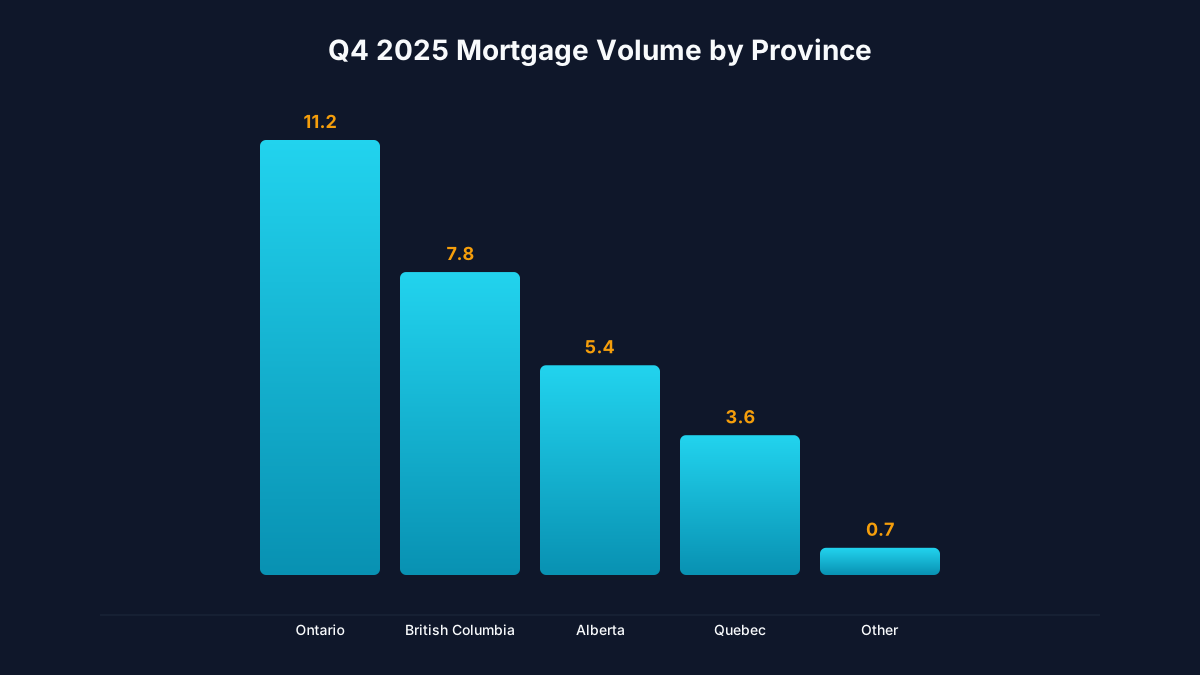
Q4 2025 Mortgage Volume by Province
Canadian Household Debt Metrics 2025-2026
The Stakes Have Never Been Higher
Here's the thing about Canada's lending market right now: it's like watching 1.15 million households approach a financial cliff in slow motion. These are the Canadians who locked in mortgage rates below 2% during the pandemic and now face renewal rates exceeding 4% — effectively doubling their interest costs overnight.
The Bank of Canada's April 29 rate decision looms large over this scenario. Markets are remarkably confident, pricing a 96% probability that Governor Tiff Macklem will keep the policy rate steady at 2.25%, where it's been parked since October 2025. But that remaining 4% chance of a hike? That's where things get interesting — and potentially painful.
A Market Caught Between Recovery and Reality
The numbers tell a fascinating story of contradictions. Q4 2025 saw mortgage borrowing surge to $28.7 billion, up 7% from the previous quarter. That's not the behavior of a market frozen by fear. In fact, it's the opposite — Canadians are jumping back into the housing market with surprising enthusiasm.
What's particularly notable is how this borrowing surge happened while non-mortgage debt actually fell. Canadians aren't loading up on credit cards or lines of credit. They're specifically targeting mortgages, suggesting a calculated bet that the worst of the rate hiking cycle is behind us.
| Metric | Q3 2025 | Q4 2025 | Change |
|---|---|---|---|
| Mortgage Borrowing | $26.8B | $28.7B | +7.1% |
| Total Household Credit | $39.1B | $36.2B | -7.4% |
| Debt-to-Income Ratio | 175.8% | 177.2% | +1.4pp |
The debt-to-income ratio climbing to 177.2% might sound alarming, but context matters. Despite higher debt levels, the debt service ratio actually edged lower thanks to easing interest costs. It's a delicate balance — households are borrowing more but finding it slightly easier to service that debt.
The Insured Mortgage Boom Nobody Saw Coming
Perhaps the most surprising development has been the 40% surge in insured mortgage volume following Q4 2024 policy changes. These changes, which took effect through 2025 and into 2026, have fundamentally altered the lending landscape.
The surge makes sense when you understand what happened. The government expanded insured mortgage eligibility, allowing more first-time buyers to access lower down payment options. Combined with stable rates and a calmer market, it created a perfect storm of opportunity for those previously priced out.
But here's where it gets interesting: this isn't just about making homeownership more accessible. It's reshaping risk distribution across the financial system. More insured mortgages mean more risk transferred from banks to government-backed insurers. In a market where everyone's worried about a potential correction, that's no small thing.
The Parent Trap: How Family Money Is Reshaping the Market
The most telling statistic might be this: parental co-signing on mortgages has nearly tripled since 2004, jumping from 4% to 11% by 2025. That's more than one in ten homebuyers needing mom and dad's signature to get approved.
What this means for borrowers is stark. With parental support, buyers can qualify for homes worth up to $787,000. Without it? They're capped around $458,000. That $329,000 gap represents the new reality of Canadian homeownership — it's increasingly a family affair.
"The Bank of Mom and Dad has become Canada's seventh-largest lender by proxy, fundamentally altering how young Canadians access homeownership."
This trend creates a two-tier system. Those with family support can still participate in the market. Those without face an increasingly impossible climb. It's widening wealth inequality in ways that will echo through generations.
Regional Divergence: Alberta's Surprising Strength
While national trends paint one picture, regional dynamics tell another story entirely. Alberta is emerging as the surprise winner in early 2026, with housing sales up 5.2% year-over-year through February. That's significantly outpacing national growth and defying expectations of a uniform slowdown.
Why Alberta? The province benefits from a unique combination of factors:
This regional strength matters because it's providing a cushion for national lending statistics. While Toronto and Vancouver grapple with affordability crises, Calgary and Edmonton are seeing genuine market expansion.
The Rate Decision Matrix: Three Scenarios
Let's break down what could happen on April 29 and what each scenario means for Canadian borrowers:
Scenario 1: Hold at 2.25% (96% Probability)
This is what markets expect, and for good reason. The Bank of Canada has signaled it's "on standby," watching geopolitical tensions and domestic conditions before making moves. A hold would:
The bottom line? Status quo helps nobody facing renewal shock but prevents further damage to new borrowers.
Scenario 2: Cut to 2.00% (Near-Zero Probability)
Markets aren't pricing this in, but stranger things have happened. A surprise cut would:
Scenario 3: Hike to 2.50% (4% Probability)
The nightmare scenario for borrowers, though bond markets are hedging this possibility. A hike would:
The Fintech Wild Card
While traditional lending dominates headlines, Canada's fintech sector is quietly revolutionizing corners of the market. Propel Holdings, an AI-driven lender, saw its lending-as-a-service revenue explode 191% year-over-year in 2025, reaching $18 million.
But here's the catch: fintech adoption among Canadian SMEs remains stubbornly low at just 30%. This gap between innovation and adoption represents both a challenge and an opportunity. As traditional lenders grapple with renewal cliffs and rate uncertainty, nimble fintech players could capture market share by offering more flexible solutions.
The securities lending market adds another dimension, with Canada and the U.S. accounting for 41% of global revenue. This $12.2 billion market is projected to grow at 5.7% annually through 2034, driven by:
These aren't just abstract numbers. Securities lending lubricates the entire financial system, enabling short selling, enhancing liquidity, and providing additional revenue streams for institutional investors. Its health directly impacts lending capacity across the system.
Looking Ahead: The 2026-2027 Outlook
Major banks are surprisingly divided on where rates go from here. While most expect rates to hold at 2.25% through 2026, 2027 projections vary wildly:
| Institution | End-2026 Forecast | End-2027 Forecast |
|---|---|---|
| RBC | 2.25% | 3.25% |
| BMO | 2.25% | 2.40% (avg) |
| National Bank | 2.25% | 2.75% |
| Scotiabank | 3.00% | 3.00% |
Scotiabank stands alone in predicting rate hikes by year-end 2026, seeing the policy rate reaching 3.00%. If they're right, it would add roughly $125 per month to payments on a $500,000 variable rate mortgage — another blow to households already struggling with renewal shock.
The 5-year government bond yield, currently hovering around 3.0%, provides another clue. TD forecasts it will average 3.05% in Q1-Q2 2026 before declining to 2.90% by Q4. Since fixed mortgage rates closely track these yields, we can expect 5-year fixed rates to remain in the 4.0-4.5% range through most of 2026.
The Human Cost of Financial Statistics
Behind every statistic is a Canadian family making difficult choices. The couple in Toronto who locked in at 1.89% in 2021 and now face renewal at 4.24%. The first-time buyer in Vancouver whose parents co-signed to make a $787,000 purchase possible. The Alberta family taking advantage of lower prices to upgrade from their starter home.
What's particularly striking is how the debt service ratio has edged lower despite higher debt levels. This suggests Canadian households are adapting — perhaps by extending amortizations, perhaps by cutting other expenses. But adaptation has limits. The real test comes when those 1.15 million renewals hit throughout 2026.
The Innovation Imperative
Canada's lending market stands at an inflection point. Traditional models are straining under the weight of rapid rate changes, shifting demographics, and evolving technology. The 40% surge in insured mortgages shows how policy changes can rapidly reshape markets. The 191% growth in fintech lending-as-a-service revenue demonstrates untapped demand for innovation.
Yet challenges remain stark:
What This Means for Borrowers
So what should Canadian borrowers do in this environment? The answer depends entirely on their situation:
For those facing renewal: Start shopping early. The difference between lenders can be substantial — often 0.5% or more. On a $400,000 mortgage, that's $2,000 per year in interest savings.
For variable rate holders: Consider your risk tolerance carefully. While markets expect rates to hold, that 4% chance of a hike isn't zero. Can your budget handle another 0.25% increase?
For potential buyers: The market is more accessible than it's been in years, especially with expanded insured mortgage options. But don't overextend based on current rates — stress test yourself at 2% higher.
For investors: The securities lending market's projected 5.7% annual growth offers interesting opportunities, particularly in funds that engage in these strategies.
The April 29 Moment of Truth
As we approach the Bank of Canada's decision, the lending market holds its collective breath. A hold seems almost certain, but markets have been wrong before. Remember, it was just two years ago that "transitory" inflation became anything but.
What's clear is that Canadian lending has entered a new era. The days of sub-2% mortgages are gone. The Bank of Mom and Dad has become a permanent fixture. Regional markets are diverging rather than converging. And technology promises disruption that traditional lenders seem unprepared for.
The April 29 decision won't solve these structural challenges. But it will set the tone for how quickly they unfold. For those 1.15 million households facing renewal, and for the millions more making borrowing decisions in 2026, the stakes couldn't be higher.
In this environment, the smartest strategy might be the oldest one: hope for the best, prepare for the worst, and remember that in Canadian lending, the only constant is change.