
The Employment Surprise That Changed Everything
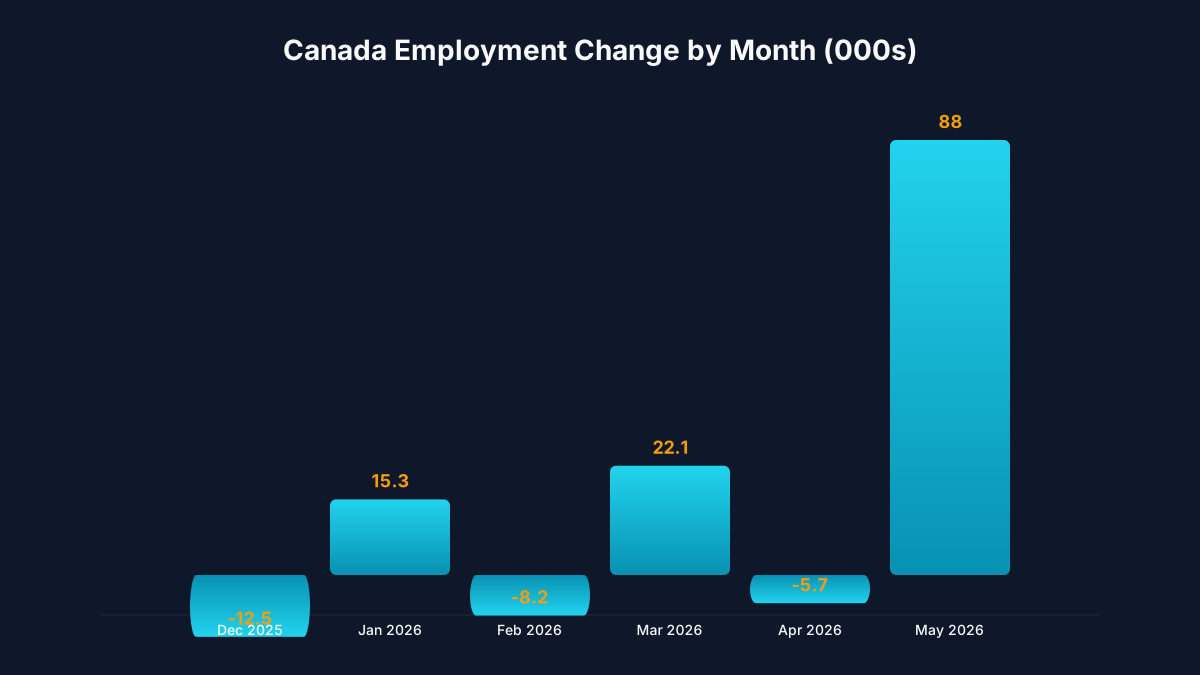
Here's the thing about economic data — sometimes it flips the script entirely. That's exactly what happened when Statistics Canada dropped its May employment report, showing the Canadian economy added 88,000 jobs, far exceeding expectations and sending the unemployment rate tumbling from 6.9% to 6.6% in a single month.
This wasn't just any job growth. The gains were broad-based and concentrated in full-time positions, with hours worked rising 0.6% after flatlining in April. Youth unemployment, often a canary in the coal mine for economic weakness, dropped to 13.4% — nearly a full percentage point lower than the previous month.
What's particularly notable is the timing. This jobs surge came after months of recession chatter, triggered by GDP contracting at an annualized rate of 1.0% in Q4 2025 and remaining essentially flat (−0.1% annualized) in Q1 2026. Major banks like RBC noted the employment data "poured cold water" on recession concerns that had been building since the start of the year.
For borrowers hoping for aggressive rate cuts, this employment strength creates a dilemma. Strong job markets typically mean central banks can afford to keep rates higher for longer, prioritizing inflation control over economic stimulus.
Inflation: Close to Target but Not Quite There
The inflation picture adds another layer of complexity to the rate outlook. At 2.8% year-over-year, headline inflation sits stubbornly above the Bank of Canada's 2% target, though well within its 1-3% control band. Core inflation, which strips out volatile items, runs cooler at 2.1% annually.
The Bank of Canada's preferred core measures paint an even more nuanced picture:
| Inflation Measure | Current Rate | Target |
|---|---|---|
| CPI-common | 2.5% | 2.0% |
| CPI-median | 2.1% | 2.0% |
| CPI-trim | 2.0% | 2.0% |
Monthly data shows inflation momentum has moderated significantly. The CPI rose 0.4% month-over-month in the latest reading, with core CPI up just 0.2% — suggesting underlying price pressures are well-contained.
What this means for borrowers: The Bank of Canada has breathing room. With inflation close to target but not creating an emergency, and employment surprisingly strong, there's no pressing need to slash rates. This "goldilocks" scenario — not too hot, not too cold — typically leads to a steady-as-she-goes monetary policy.
RBC economists note that while oil prices have recently spiked, pushing headline inflation back above 2%, there's "little evidence so far" that higher energy costs are feeding into broader inflation. This gives the central bank additional comfort in maintaining its patient approach.
The Housing Market's Delicate Dance
After months of decline, Canada's housing market is showing tentative signs of life. The CREA Home Price Index rose 0.7% in Q1 2026 (not seasonally adjusted), marking the first quarterly gain after three consecutive declines. This stabilization suggests the worst of the housing correction may be behind us.
But here's where it gets interesting — new home prices are telling a different story. The New Housing Price Index fell 0.4% month-over-month in the latest reading, following a 0.3% decline the previous month. This divergence between resale and new home prices reflects the complex dynamics at play:
The mortgage rate environment adds another wrinkle. Five-year Government of Canada bond yields, which influence fixed mortgage rates, rose about 10 basis points over the past week. Ten-year yields climbed 8 basis points. These moves, while modest, tighten financing conditions for borrowers at the margin.
RBC expects housing to contribute moderately to household net worth growth but cautions that debt accumulation continues to offset some of these gains. For prospective homebuyers, this creates a frustrating scenario — prices are stabilizing (making waiting risky) but financing costs remain elevated (making buying expensive).
What This Week's Bank of Canada Decision Means
Markets and economists are nearly unanimous: the Bank of Canada will hold its policy rate steady this week, marking a fifth consecutive pause. TD Economics and RBC both expect no change, with RBC suggesting rates may not move until 2027 in their base case scenario.
The central bank faces a delicate balancing act:
Arguments for holding steady:
Arguments for eventual cuts:
The bottom line? The Bank of Canada can afford to wait and see. Strong employment data has bought them time, while contained inflation means there's no urgency to act in either direction.
The Real Impact on Canadian Borrowers
So what does all this mean for regular Canadians looking to borrow? The implications vary significantly by loan type:
Variable-Rate Mortgages and HELOCs
These borrowers remain in limbo. With the Bank of Canada expected to hold steady, prime rates won't budge this week. The anticipated relief that many variable-rate holders have been hoping for since rates peaked appears pushed out to late 2026 or even 2027.
Current variable-rate mortgage holders face a stark choice:
Fixed-Rate Mortgages
The bond market moves tell the story here. With five-year yields rising 10 basis points, fixed mortgage rates are more likely to edge up than down in the near term. This creates urgency for anyone sitting on the fence about locking in a rate.
Personal and Auto Loans
These products typically reprice more slowly than mortgages but follow the same general trajectory. With the rate environment stable, expect little change in the near term. However, strong employment should mean continued credit availability for qualified borrowers.
Business Loans
The stable rate environment provides predictability for business planning, though borrowing costs remain historically elevated. The key advantage: with employment strong and recession fears receding, lenders may be more willing to extend credit than during periods of economic uncertainty.
Regional Variations Tell Different Stories
Canada's economic indicators mask significant regional variations that matter for local lending markets:
The Energy Factor
Rising oil prices benefit Alberta and Saskatchewan, where energy sector employment and investment drive local economies. These provinces may see stronger loan demand and better credit performance than the national average.
Urban vs. Rural Divide
Major urban centers like Toronto and Vancouver face unique affordability challenges despite the broader economic strength. Rural markets, with lower price points, may see more activity as remote work enables geographic flexibility.
Manufacturing Belt
Ontario's manufacturing heartland watches nervously as global trade tensions simmer. While current employment is strong, this sector's sensitivity to international conditions creates uncertainty for longer-term lending.
Looking Ahead: Three Scenarios for Borrowers
As we look toward the remainder of 2026 and into 2027, three distinct scenarios emerge for Canadian borrowers:
Scenario 1: The Soft Landing (Most Likely)
This scenario, currently priced into markets, suggests patience will be required. Borrowers should prepare for rates to remain elevated through most of 2026, with relief coming gradually rather than dramatically.
Scenario 2: The Stubborn Inflation Surprise
While less likely given current core inflation trends, this scenario can't be dismissed entirely. A global energy shock or stronger-than-expected wage pressures could force the Bank's hand.
Scenario 3: The Rapid Slowdown
This scenario would bring the fastest rate relief but at the cost of economic pain. The May employment data makes this less likely in the near term, but economic cycles can turn quickly.
Practical Strategies for Different Borrower Types
Given the current environment, different borrowers should consider distinct strategies:
First-Time Homebuyers
The stabilizing housing market creates a dilemma — wait for lower rates and risk higher prices, or buy now and accept elevated borrowing costs. Key considerations:
Existing Homeowners
With home prices stabilizing and rates elevated, the refinancing boom is over. Focus on:
Investors and Business Owners
The stable but elevated rate environment requires careful planning:
The Deeper Story: Canada's Economic Transformation
Beyond the weekly data points lies a deeper transformation in Canada's economy. The pandemic accelerated shifts that continue to reshape lending markets:
The Remote Work Revolution
Permanent remote work arrangements are redistributing housing demand from expensive urban cores to smaller cities and rural areas. This geographic arbitrage creates new lending opportunities in previously overlooked markets while potentially softening demand in traditional hotspots.
The Demographic Shift
Canada's aging population creates competing pressures — retirees downsizing add supply to family home markets while requiring different financial products. Lenders must adapt to serve both ends of the demographic spectrum.
The Energy Transition
Canada's resource economy faces transformation as global energy markets evolve. This creates both risks and opportunities for lenders exposed to traditional energy sectors while opening new markets in renewable energy and clean technology.
The Productivity Challenge
Despite strong employment, Canada's productivity growth remains weak. This structural challenge limits the economy's potential growth rate and, by extension, the neutral level for interest rates. Borrowers should prepare for a world where "normal" rates are higher than the ultra-low levels of the 2010s.
What to Watch in Coming Weeks
Several key indicators will shape the lending environment through summer 2026:
Bank of Canada Communications
Beyond this week's rate decision, watch for nuances in the Bank's statement and any speeches by Governor Tiff Macklem. Key phrases about the "balance of risks" or "appropriate time" for policy adjustments can move markets.
U.S. Federal Reserve Actions
Canadian rates can't diverge too far from U.S. rates without currency implications. The Fed's approach to its own inflation challenge will influence the Bank of Canada's flexibility.
Housing Market Data
June typically marks the peak selling season. Strong sales data would confirm the housing recovery; weakness would suggest the stabilization is fragile.
Commodity Prices
Oil prices above $80/barrel help Canada's economy but complicate the inflation picture. A sustained move higher could delay rate cuts.
Global Economic Conditions
China's recovery, European energy security, and global trade tensions all affect Canada's small, open economy. Any significant shock could quickly change the domestic outlook.
The Bottom Line for Borrowers
What this means for borrowers is clear: the hoped-for return to ultra-low rates isn't coming soon. The surprise strength in employment, combined with sticky inflation and a stabilizing housing market, gives the Bank of Canada every reason to maintain its patient approach.
This isn't necessarily bad news. A strong job market means Canadians can service their debts even at higher rates. Stable policy provides predictability for planning. And avoided recession means credit remains available for those who qualify.
The key is adjusting expectations. Rather than waiting for dramatic rate cuts that may not materialize, borrowers should make decisions based on current conditions while building flexibility for various scenarios.
For those who locked in low rates during the pandemic, congratulations — you won the lottery. For everyone else, it's time to accept that the new normal involves higher borrowing costs, offset hopefully by stable employment and gradually improving economic conditions.
The May employment surprise reminds us that economic data can shift narratives quickly. While this week's numbers pushed rate relief further into the future, they also reduced recession risk and supported credit availability. In the complex world of lending, sometimes good news is bad news — and vice versa.
As we await the Bank of Canada's decision this week, remember that monetary policy works with long and variable lags. Today's hold is tomorrow's stability, and patience, while frustrating, may prove the wisest strategy in navigating Canada's evolving economic landscape.