
The Rising Tide of Canadian Household Debt
Here's the thing about debt-to-income ratios: they're like cholesterol levels for the economy. And Canada's just hit 177.2% — meaning for every dollar of disposable income, Canadian households now owe $1.77. That's up from 176.3% just three months earlier, continuing a relentless upward march that has economists reaching for their worry beads.
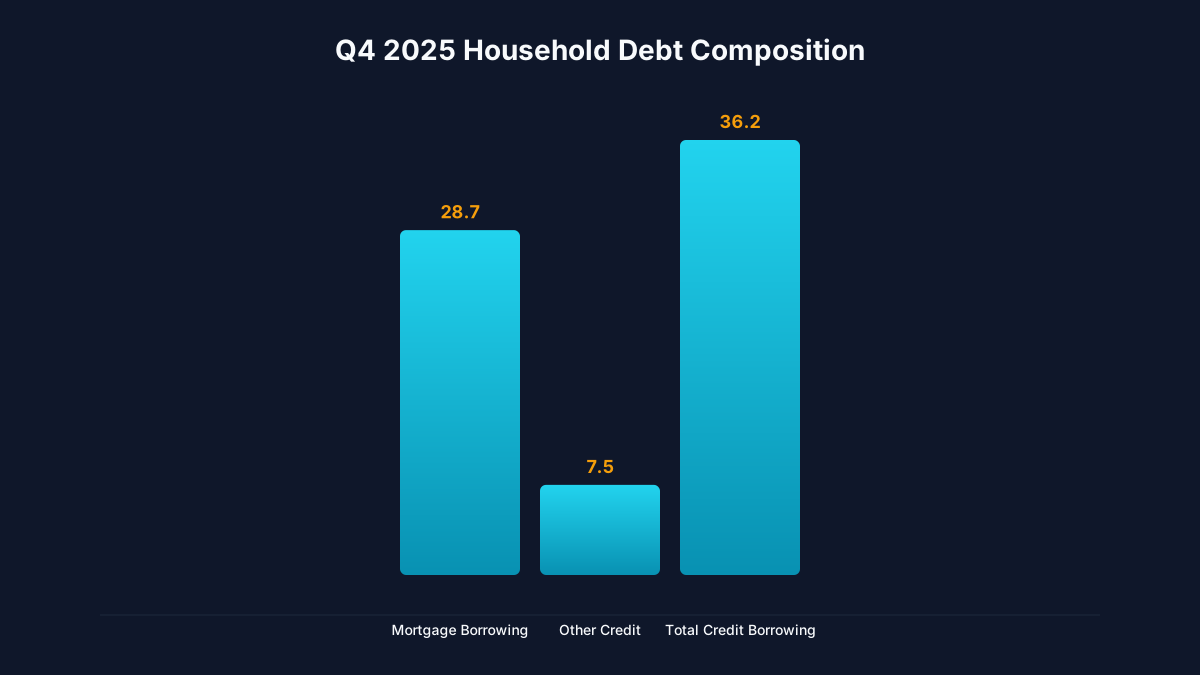
The numbers tell a stark story. Total household credit market debt reached $3.23 trillion by February 2026, jumping 4.5% year-over-year. That's $138.4 billion in new debt added in just twelve months — roughly equivalent to the entire GDP of Kuwait. The bulk of this borrowing? Mortgages, which saw quarterly borrowing accelerate to $28.7 billion in Q4 2025.
What's particularly notable is the timing. This debt accumulation is happening just as disposable income growth has slowed to a crawl — rising just 0.6% in the final quarter of 2025. It's like trying to fill a bathtub while the drain is wide open.
Breaking Down the Numbers: Where the Money Goes
The composition of this debt mountain reveals important patterns about Canadian borrowing behavior:
| Debt Component | Q3 2025 | Q4 2025 | Change | Trend |
|---|---|---|---|---|
| Mortgage Borrowing | $26.8 billion | $28.7 billion | +$1.9 billion | Accelerating |
| Total Credit Borrowing | Not specified | $36.2 billion | Slowing overall | Mixed signals |
| Household Savings Rate | 5.2% | 4.4% | -0.8 pp | Declining |
The mortgage acceleration is particularly concerning given the broader economic context. While overall credit borrowing has slowed — suggesting Canadians are pulling back on credit cards and lines of credit — they're doubling down on housing debt. This creates a peculiar vulnerability: households are increasingly leveraged to a single asset class just as that asset class faces its own pressures.
The Housing Affordability Crisis Deepens
Speaking of housing pressures, March 2026 data from the Canadian Real Estate Association (CREA) paints a troubling picture across Canada's major markets. The national sales-to-new-listings ratio held at 47.8% — balanced territory — but regional averages tell a much sharper story:
| City | March 2026 Avg Price | Year-Over-Year Change | Source |
|---|---|---|---|
| Greater Vancouver | $1,201,522 | -3.0% | CREA |
| Greater Toronto | $1,017,796 | -6.7% | CREA |
| Victoria | $1,027,854 | +4.0% | CREA |
| Calgary | $656,109 | +0.3% | CREA |
| Edmonton | $465,237 | +2.2% | CREA |
| Montreal | $665,120 | +4.7% | CREA |
| National Average | $673,084 | -0.8% | CREA |
What this means for borrowers is straightforward: even as Toronto and Vancouver prices ease modestly, the dream of homeownership in those markets remains out of reach for most households. A Greater Vancouver buyer is still looking at over $1.2 million for an average property, while Greater Toronto sits just above $1 million. Affordability gains in B.C. and Ontario are being offset by mid-month spikes in fixed mortgage rates, which CREA's senior economist Shaun Cathcart cited as the main reason early-spring activity stalled.
Meanwhile, mid-sized markets are running the opposite direction. According to CREA, Saskatoon led the country in March with a 13.8% year-over-year price gain to $460,867, followed by Trois-Rivières (+14.3% to $449,128) and Thunder Bay (+11.5% to $378,030). The national average home price of $673,084 masks this growing two-speed market — Atlantic Canada, Quebec, Saskatchewan, and Alberta continue to gain ground while Ontario and B.C. correct.
Interest Rates: The Sword of Damocles
The interest rate environment adds another layer of complexity to the debt picture. As of late April 2026, the mortgage landscape looks like this:
That stress test rate deserves special attention. At 6.39%, it means borrowers must qualify for their mortgages as if rates were nearly double what they're actually paying. This creates a safety buffer, but it also limits how much Canadians can borrow — pushing many out of the market entirely.
The bottom line? Rising bond yields are pushing fixed rates higher. The 5-year Government of Canada bond yield has crept above 3%, signaling that the era of ultra-low rates is definitively over. For variable-rate holders, the 3.35% rate might look attractive now, but it comes with the risk of future Bank of Canada rate hikes.
The Debt Service Paradox
Here's where things get interesting — and a bit counterintuitive. Despite the rising debt-to-income ratio, the household debt service ratio actually edged lower in late 2025. How is this possible?
The answer lies in the composition of debt and the timing of interest rate changes. Many Canadians locked in low rates during the pandemic era and haven't yet faced renewal. Others have benefited from the Bank of Canada's pause in rate hikes since July 2023. The result is a temporary reprieve in debt servicing costs even as total debt levels climb.
But this relief is likely to be short-lived. As mortgages come up for renewal over the next few years, households will face the reality of higher rates. A mortgage that was locked in at 2.5% in 2021 might renew at 4.5% or higher in 2026 — potentially adding hundreds of dollars to monthly payments.
Net Worth: The Silver Lining?
It's not all doom and gloom. Canadian household net worth reached $18.6 trillion in Q4 2025, up $230.2 billion from the previous quarter. This marks nine consecutive quarters of expansion, driven primarily by equity market gains.
This wealth effect provides an important buffer against debt concerns. Households with substantial assets can weather financial storms more easily than those living paycheck to paycheck. However, this aggregate figure masks significant inequality — not all Canadians have benefited equally from rising asset values.
The wealth gains are concentrated among older, asset-owning households, while younger Canadians face the double whammy of high debt and limited asset accumulation opportunities.
Regional Variations: A Tale of Many Markets
The debt burden isn't distributed evenly across Canada. Major urban centres face very different pressures:
Toronto and Vancouver: The Heavyweight Champions
CREA reports Greater Toronto's average price at $1,017,796 in March 2026 (down 6.7% year-over-year) and Greater Vancouver at $1,201,522 (down 3.0%). Even with these declines, both markets require household incomes well above $200,000 to enter — driving extreme leverage among recent buyers and permanent renting for many households shut out by stress-test math.
The Quebec Surge
Quebec markets continued to gain ground in March 2026 according to CREA. Quebec CMA prices rose 9.1% year-over-year to $486,768 and Montreal climbed 4.7% to $665,120, with new listings jumping more than 20% in several Quebec cities. As affordability erodes in Ontario and B.C., demand and price pressure are migrating east.
The Prairie Perspective
Alberta continues to offer relative stability. CREA reports Calgary at $656,109 (+0.3% YoY) and Edmonton at $465,237 (+2.2% YoY) in March 2026 — Edmonton sits roughly $208,000 below the national average, making it one of the country's best-value major markets for first-time buyers.
The Inflation Wild Card
February 2026's inflation rate of 1.8% sits comfortably below the Bank of Canada's 2% target. This might suggest room for the central bank to maintain or even cut rates. But energy-driven inflation risks loom on the horizon, creating uncertainty about future monetary policy.
What this means for borrowers: the current period of relative rate stability might not last. The Bank of Canada faces a delicate balancing act between supporting economic growth and preventing inflation from reigniting. Any miscalculation could send rates higher, adding stress to already stretched households.
Structural Vulnerabilities: The Bigger Picture
The 177.2% debt-to-income ratio represents more than just a number — it's a structural vulnerability in the Canadian economy. When debt consistently grows faster than income, it creates several risks:
Looking Ahead: Scenarios for 2026 and Beyond
As we move deeper into 2026, several scenarios could unfold:
The Soft Landing
In this optimistic scenario, income growth accelerates, catching up to debt levels. The Bank of Canada maintains steady rates, and house prices plateau rather than crash. Households gradually repair their balance sheets without major disruptions.
The Stress Test
Here, rising rates combine with economic slowdown to create genuine household stress. Mortgage renewals at higher rates force spending cuts, creating a negative feedback loop that slows the economy further. The debt service ratio, currently providing relief, becomes a burden.
The Reset
The most dramatic scenario involves a significant correction in house prices, forcing a broader deleveraging. While painful in the short term, this could restore affordability and create a more sustainable debt-to-income balance.
Practical Implications for Borrowers
For individual Canadians navigating this environment, several strategies emerge:
Lock in Certainty: With rates trending higher, locking in fixed-rate mortgages provides payment certainty. The premium over variable rates represents insurance against future increases.
Stress Test Yourself: Don't rely on minimum qualifying standards. Calculate your budget at rates 2-3% higher than current levels to ensure sustainability.
Accelerate Payments: With debt levels high, any additional payments toward principal provide outsized benefits. Even small increases in payment frequency can significantly reduce total interest costs.
Diversify Income Sources: In an environment where debt grows faster than wages, multiple income streams provide crucial flexibility.
The Role of Policy Makers
Government and regulatory responses will shape how this debt story unfolds:
Macro-Prudential Measures
Potential tools include tighter stress tests, restrictions on highly leveraged lending, or regional cooling measures for hot markets.
Fiscal Policy
Tax policy could either support or discourage certain types of borrowing. First-time buyer incentives must be balanced against the risk of further inflating prices.
Housing Supply
Ultimately, addressing the supply-demand imbalance in housing markets represents the most sustainable solution to affordability challenges.
Conclusion: Navigating Uncharted Waters
Canada's 177.2% household debt-to-income ratio represents uncharted territory for the economy. While household net worth gains and lower debt service ratios provide some cushioning, the fundamental imbalance between debt growth and income growth creates systemic vulnerabilities.
For borrowers, the message is clear: proceed with caution. The current environment rewards prudence over speculation, and preparation over complacency. While the Canadian economy has shown remarkable resilience through past challenges, the combination of high leverage and affordability pressures creates risks that demand respect.
The coming months will likely bring more clarity on whether this debt accumulation represents a manageable evolution of household finances or a precursor to more significant adjustments. Either way, Canadian borrowers must navigate carefully, balancing the desire for homeownership and consumption with the reality of finite income growth and potentially higher future rates.
As we've seen throughout this analysis, the debt story isn't just about numbers — it's about choices. Individual choices about borrowing and spending. Policy choices about rates and regulations. And collective choices about what kind of economy we want to build. The 177.2% figure is where we are today. Where we go from here depends on the decisions we make next.