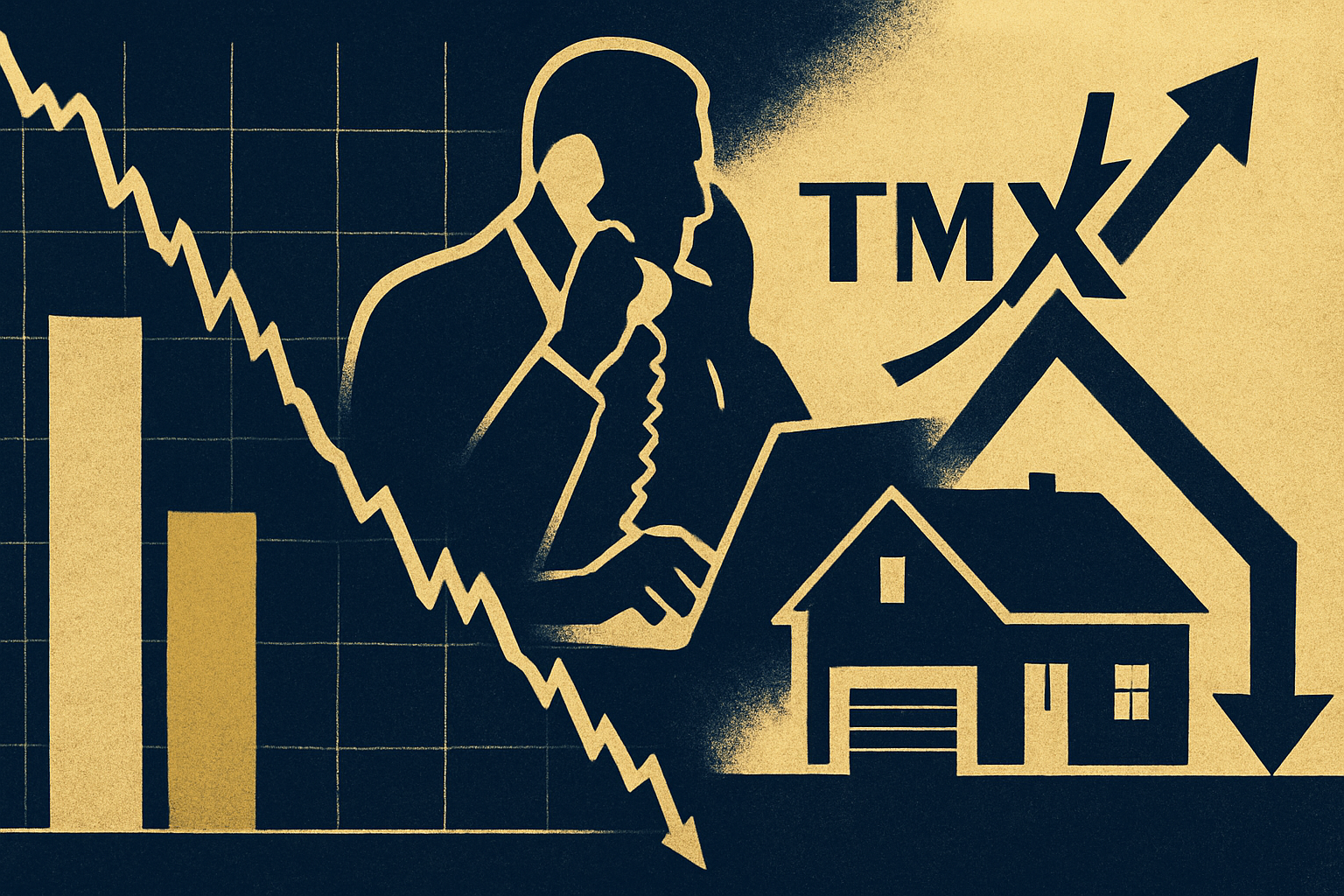
Morning Briefing: TSX Drops 550 Points, TMX Buys Cboe Canada, Hamilton Homes Fall 8.6%
Good morning. The Canadian financial landscape shifted dramatically yesterday as markets tumbled and deal activity accelerated. Here's what happened while you were sleeping — and what it means for your money.
Market Mayhem: TSX Plunges 550+ Points
Tuesday's trading session was brutal. The TSX index dropped more than 550 points on April 21, mirroring similar carnage south of the border. The catalyst? Uncertainty surrounding U.S.-Iran ceasefire talks that sent oil prices soaring and investor confidence plummeting.
This wasn't just a minor correction — it was the kind of single-day drop that makes portfolio managers reach for the antacids. When geopolitical tensions spike, Canadian markets feel it doubly hard given our resource-heavy economy. Oil and gas stocks likely led the charge downward, though the ripple effects touched virtually every sector.
TMX Makes Its Move: Acquiring Cboe Canada
While markets were melting down, Cboe Global Markets announced on April 22 an agreement to sell Cboe Australia and Cboe Canada to TMX Group. This is huge for Canadian financial infrastructure.
TMX Group, which operates the Toronto Stock Exchange, is essentially consolidating its grip on Canadian equity trading. While financial terms weren't disclosed, this deal represents a significant shift in how Canadian securities will be traded. For retail investors, this could mean changes to trading fees, platform access, and market liquidity down the road.
The timing is interesting — acquiring assets during market uncertainty often means getting a better price. TMX is clearly betting on long-term growth in Canadian capital markets, even as short-term volatility rattles nerves.
Housing Reality Check: Hamilton Prices Crater
Hamilton's average home price fell 8.6% year-over-year to $721,075 in March 2026, with the market showing 4 months of supply amid 451 sales and 1,078 new listings. This isn't just a minor correction — we're talking about prices falling below March 2021 levels, effectively erasing pandemic-era gains.
The breakdown tells the whole story:
| Property Type | Average Price | YoY Change |
|---|---|---|
| Detached Homes | $807,952 | -7.7% |
| Semi-Detached | $648,425 | -6.2% |
| Townhouses | $630,671 | -7.3% |
| Condo Apartments | $388,264 | -13.3% |
Condos got hit hardest with a 13.3% decline. That's not a market adjustment — that's a rout. Regional variations show Burlington at $1,066,134 (-10.3%) and Haldimand at $687,480 (-8.8%), though Niagara North bucked the trend at $841,255 (+3.8%).
The broader picture is even grimmer. A "Participation Crisis" has frozen GTA and Toronto markets due to collapsing buyer confidence. Over 20,000 condo units are set to close in 2025-2026, while 1.2 million mortgage renewals in the same period risk payment shocks for homeowners. If you're thinking about refinancing, our AI loan advisor can help you navigate these choppy waters.
Bank of Canada: The Calm Before Next Week's Storm
No rate decision this week — the Bank of Canada's next scheduled announcement is April 29, 2026. The current rate sits at 2.25% from the March 17 decision, but with markets in turmoil and housing prices falling, Governor Macklem faces a complex decision next week.
Market volatility usually pushes central banks toward caution, but falling home prices might give the BoC room to maneuver without stoking another housing bubble. The March decision held steady, but economic data since then suggests pressure is building for action.
Data Dump Day: What Statistics Canada Reveals
Today brings a flood of economic indicators at 12:30 PM ET, including some eye-popping forecasts. Canada's PPI is forecast to jump 1.3% month-over-month with a 6.5% year-over-year increase, while raw materials prices could rise 1.8% monthly after a 0.6% gain previously.
Manufacturing sales forecasts show a 2.2% monthly increase following March's strong 3.6% gain. If these numbers hit, they'll paint a picture of an economy still growing despite market turmoil — which could complicate the BoC's rate decision next week.
The afternoon brings Bank of Canada business and consumer surveys at 2:30 PM, followed by budget balance data at 3:00 PM showing an actual deficit of C$5.07 billion. These sentiment surveys often provide more insight than hard data about where the economy is heading.
The Week Ahead: April 29 Looms Large
Next Tuesday's BoC decision just became infinitely more complex. Market chaos, falling home prices, and today's economic data create a perfect storm of conflicting signals. Add geopolitical tensions affecting oil prices — a key Canadian export — and you have a central banker's nightmare.
The housing market's "Participation Crisis" might actually help the BoC's credibility if they can show they're not just reactive to market swings. But with 1.2 million mortgage renewals coming, any rate increase could trigger the payment shocks already brewing.
FAQ: Today's Financial News
How much did Canadian markets fall yesterday?
The TSX index dropped more than 550 points on Tuesday, April 21, 2026, representing one of the largest single-day declines in recent months, driven primarily by geopolitical uncertainty around U.S.-Iran ceasefire negotiations.
What's happening to Hamilton house prices?
Hamilton's average home price fell 8.6% year-over-year to $721,075 in March 2026, with condo apartments hit hardest at a 13.3% decline to $388,264, effectively erasing pandemic-era price gains.
When is the next Bank of Canada rate decision?
The Bank of Canada's next scheduled interest rate announcement is April 29, 2026, with the current policy rate sitting at 2.25% since the March 17, 2026 decision.
Sources
- TSX falls more than 550 points, US stock markets also negative as oil prices rise — Business in Vancouver
- Cboe Announces Agreement to Sell Cboe Australia and Cboe Canada to TMX Group — Cboe Global Markets
- Hamilton Housing Market Report — WOWA
- Interest Rate Announcement and Monetary Policy Report – April 29, 2026 — Bank of Canada